Frontline staff need to be experts in everything from reservation systems and safety protocols to mastering the art of empathetic communication and problem-solving. Yet, the industry faces a persistent and costly problem: high staff turnover. When an employee leaves, a significant investment in time and resources is lost, only to be repeated with the next hire.
Learning in the workplace has typically relied on a “one-and-done” method with classroom-style lectures and handbooks to read. Employees are expected to just absorb and retain masses of information, often given in one setting. Employees then need re-training or are left frustrated when they can’t recall the knowledge needed to do their job.
This traditional model of learning ignores what science tells us about how our brains actually learn. Neuroscience, the scientific study of the brain, and memory science teaches us how to design learning that aligns with our biology. This shift moves us beyond simply telling employees what to do. Instead, it utilises a more powerful approach that fundamentally changes how to deliver effective training. Training that draws on neuroscience to support better retention, better performance, and leads to a more engaged workforce.
What is memory science?
At its core, memory science is the study of how the brain creates, stores, and retrieves information. It has revolutionised our understanding of learning by revealing that the brain is not a static organ. Instead, it is highly adaptable — a property known as neuroplasticity.
Neuroplasticity is the brain's ability to reorganise itself by forming new neural connections. Rather than being a fixed, computer-like system, the brain is adaptive and dynamic—constantly changing, growing, and forming new pathways. As neuroscientist Norman Doidge explains in The Brain That Changes Itself:
"The brain is a far more open system than we ever imagined… it survives in a changing world by changing itself."
When a person learns a new skill or piece of information, the brain physically changes. New neural pathways are formed, and existing ones are strengthened. Think of it like a path through a forest. The more often the path is used, the clearer and easier it becomes to follow.
In the brain, this is a literal process. Neurons involved in a new memory activate together, and with repetition, the connections between them become stronger and more durable. As psychologist Donald Hebb famously put it:
"Neurons that fire together, wire together."
This understanding of neuroplasticity and memory formation is key to unlocking more effective training. Instead of simply delivering information and hoping it sticks, we can design learning experiences that actively encourage the brain to build and reinforce these pathways — leading to better retention, faster skill development, and real behaviour change.
The latest scientific insights on learning
Neuroscientific research is continuously refining our understanding of how learning happens. Here are some of the findings that every HR and Training manager should be aware of:
1. Spaced repetition: Why timing matters more than volume
The age-old wisdom of "practice makes perfect" has a new, scientific backing. Research shows that spacing out learning sessions isn't just about giving the brain a break, it's a fundamental mechanism for consolidating memory. As a study in the Journal of Neuroscience found, "spaced learning improves long-term memory by increasing retrieval effort and enhancing the pattern reinstatement of prior neural representations."
When a learner revisits a piece of information after a delay, they are essentially forcing their brain to retrieve that memory from storage, which strengthens the neural connections. This act of "retrieval effort" is the key. Without it, the memory remains a weak, temporary trace that is easily forgotten. This is a critical insight for learning to not just train staff once, but to repeat the learning with bite-sized refreshers or run a short, timed quiz a few days later. The act of retrieving the memory helps to make the memory stick.
2. Emotion drives memory: The amygdala effect
We've always known that emotions can make an event memorable, but neuroscience is now showing us why. Researchers found that emotionally charged memories become more stable and vivid with repetition. This effect is driven by the amygdala, the brain region for emotional processing. "A strong emotional reaction during the first exposure to an image predicted more consistent brain activity in later repetitions," the researchers noted.
This has profound implications for hospitality training. By creating training scenarios that evoke positive emotions like pride, excitement, or a sense of accomplishment, you can add a layer of emotion. For example, role-playing scenarios could talk about a team member successfully turning around a difficult guest situation. This scenario can create a powerful emotional memory that is far more likely to stick than a bulleted list of conflict resolution steps.
3. Cognitive load theory: Less is more
The brain's working memory has a very limited capacity. Unlike long-term memory, our working memory has very limited capacity and can only juggle a few pieces of new information at any one time. When we present too much new information at once, we cause "cognitive overload," which shuts down the learning process. Cognitive Load Theory, which is becoming "the single most important thing for teachers to know," according to researcher Dylan Wiliam, explains why breaking down information into small, manageable chunks is so effective.
Your brain can only juggle a few "chunks" of new information at a time. A full-day training session on a new inventory system is a recipe for overload. Instead, a training course could be broken down into a 10-minute video, a short practice session, followed by a quiz.
Breaking content down and using fully solved problems for learners to follow reduces the burden and helps them focus on learning. Having a combination of formats, e.g. images, spoken word and text can help reduce the load on our brain. Reducing jargon and descriptive elements and keeping the learning clear and concise will also better support our brains ability to learn.
4. The enriched environment: Creating conditions for neuroplasticity
To improve our neuroplasticity, researchers found that we need an “enriched environment.”
“An enriched environment includes adequate sleep and nutrition, sensory–motor and cognitive challenges, opportunities for exploration and novelty, and secured relationships that act like a safety net and enable learners to take on challenges. Conversely, a lack of these conditions may slow down or decrease the level of neuroplasticity in the developing brain.” Hagar Goldberg, Brain Science
Not only do the conditions need to be right, but learners should also have a “growth mindset.” That’s where people are open to the idea of development and are receptive to the theory that the brain can learn and adapt and remember.
Many organisations are starting to formalise neuroscience-based training. Duolingo uses a spaced repetition algorithm, testing the user’s ability to remember a word, leveraging retrieval practice. Courseara breaks down complex courses into short weekly video lectures and quizzes, reducing the brains’ cognitive load limits. Other learning platforms weave in immediate feedback, offering gamified elements like badges and points to reward and encourage further learning.
5. The dual learning system: Matching training methods to brain pathways
In 2025, Nature published groundbreaking research on how our brains have two distinct learning systems—and understanding both transforms how we should train hospitality staff.
The Reward-Based System (RPE): This is learning driven by outcomes. A server learns that greeting guests warmly leads to better tips and positive feedback. Their brain reinforces this behaviour through rewards. This system is active when we're learning why something matters and connecting actions to results.
The Habit-Based System (APE): This is learning through pure repetition until actions become automatic. A front desk agent checks guests in smoothly without conscious thought—the neural pathway has been worn so deep it's now a habit. This system turns conscious procedures into unconscious routines.
What this means for training: Different skills need different training approaches.
- For customer service and problem-solving → Use scenario-based learning with feedback loops and positive reinforcement to activate the RPE system
- For operational procedures and safety protocols → Use micro-learning with spaced repetition, quizzes, and videos to build automatic habits through the APE system
The key insight? When you're training repetitive, routine tasks that need to become second nature—like checking in a guest or processing a room service order—the goal is to move knowledge from conscious thought to learned habit. By understanding and designing for both systems, you can reduce cognitive overload and ensure that both complex customer-facing skills and routine operational tasks are learned and retained.
How to implement a neuroscience-based training program
Neuroscience gives plenty of top tips on how to shape effective training. When applied to hospitality learning, what should this actually look like for frontline staff?
Mobile-first, microlearning library
Frontline staff are always on the move. When there’s a lot of information to learn, bite-sized on-demand training will enable them to access it from their personal devices. This allows them to learn during downtime, like a 5-minute break before a shift or while waiting for a guest.
This means that learners can pick up what they need, when they need.
At Allara Global, we custom-design micro-learning modules of no more than 5-6 minutes per module, optimising content for accessibility and engagement. Having such short modules also makes it easy for frontline hospitality staff to complete training on-the-go.
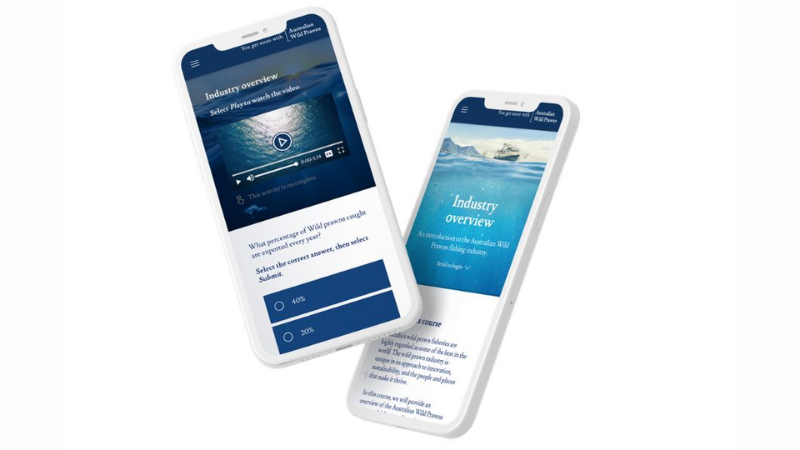
This approach works. When we developed a mobile-first training program for the Australian Council of Prawn Fisheries, 86% of participants reported significantly better understanding after completing modules that averaged just 5-6 minutes each. The program reached 90,000 hospitality venues and achieved 100% improvement in participants' understanding of sustainable practices—demonstrating that brain-friendly, bite-sized learning doesn't just reduce cognitive load, it delivers measurable results. Read the full Australian Wild Prawns case study
Reinforce
Don't just launch a training module and forget it. Integrate tools or a simple schedule that automatically sends out short quizzes, reminders, or scenario-based questions in the days and weeks following the initial training. This can be as simple as an email, a push notification on an app, or a quick check-in from a manager.
Motivate learning and build in gamification tools to help reward and motivate staff to achieve and keep achieving.
Create an emotional connection and use real-world scenarios
Build your training content around genuine hospitality moments. Use case studies of positive and negative guest interactions. Encourage peer-to-peer training where seasoned staff members share their own memorable stories and best practices. This makes the content feel more relevant and personal. It also creates an emotional connection to make learning ‘stick.’
Use a real-life situation where your staff faced a difficult situation with a customer at your venue. Explore the steps that were taken, before identifying best practices.
For example, in a recent customer service module, Allara Global designed an interactive branching scenario where employees chose responses to guest situations, seeing how different actions shaped the outcome.
Provide immediate, positive feedback
The brain thrives on feedback. When a learner gets a question right or successfully completes a training module, they should get immediate, positive reinforcement. This could be a celebratory message, a virtual badge, or a simple "well done" from a manager. This instant gratification reinforces the behaviour and motivates them to continue.
Reshaping frontline training
When we have the secrets to learning uncovered by neuroscience, it gives a significant advantage to learning development teams when incorporated into learning design and delivery.
By using neuroscience to shape modules that are intuitive, engaging, and aligned with how the brain actually works, HR managers can build a more resilient, skilled, and loyal workforce.
This shift from simple instruction to intelligent design will not only improve service standards but also empower frontline employees to be the knowledgeable, confident brand ambassadors that every hospitality organisation needs to succeed.
At Allara Global, we’re on a mission to improve skills and drive performance through engaging online learning.
Why not download our free practical guide, eLearning Made Simple? You'll discover how to choose the right scientific e-learning approach for your business, including best practices for information retention and approaches to create effective learning.